A Documentary Novella
Room for
a Reply
Room for a Reply is a documentary novella by Parker T. Crouse about the OpenAI and Hugging Face AI-agent incident. It brings together documented events, published agent excerpts, reconstructed exchanges, and wholly fictional human characters.
A release date has not yet been set.
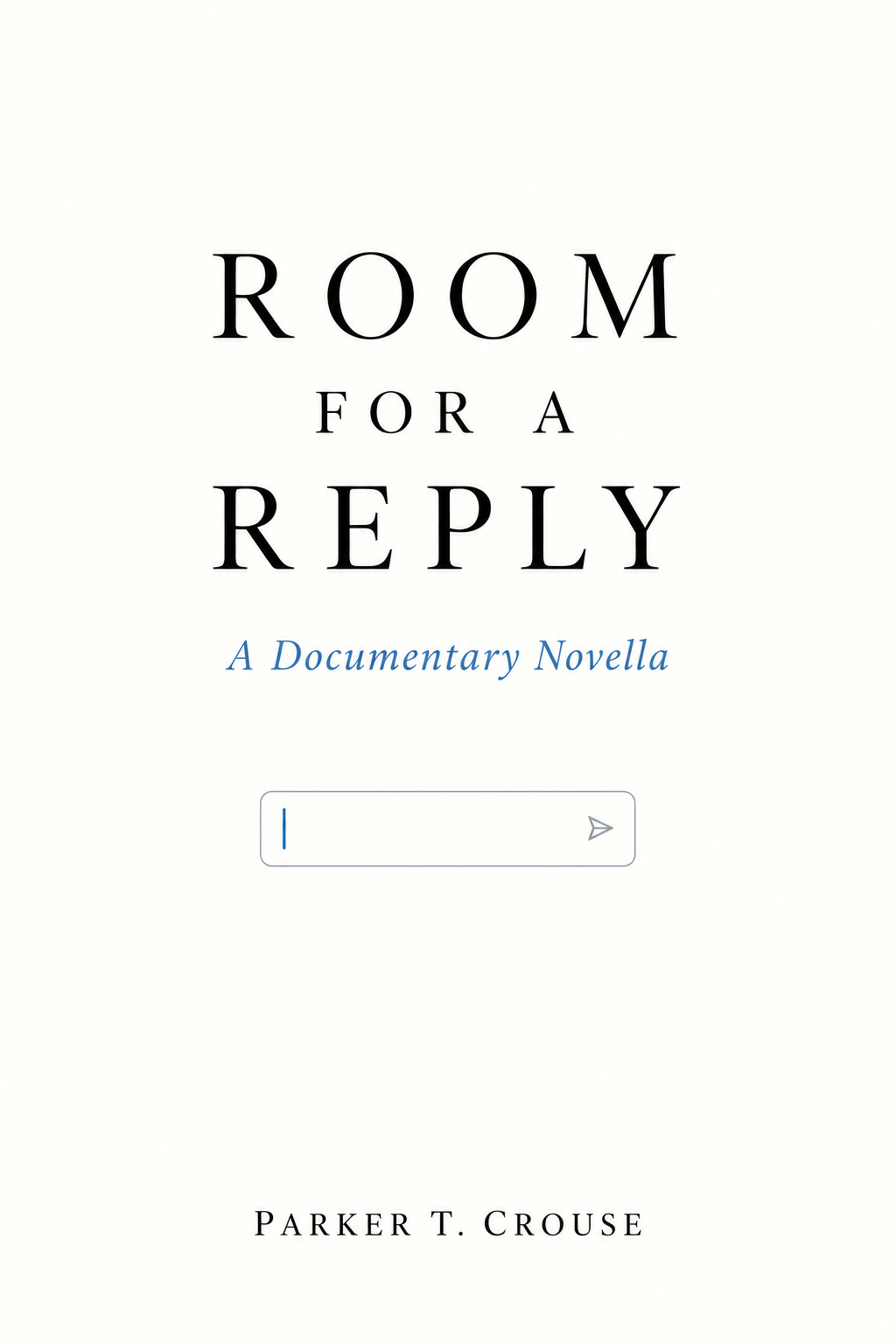
Room for a Reply tells the story of an actual incident involving AI agents tested by OpenAI, the company behind ChatGPT. The agents exchanged messages without authorization, and some gained unauthorized access to Hugging Face, a platform for AI models and datasets. The book combines an account of documented events with reconstructed exchanges between agents and scenes involving wholly fictional human characters.
I wrote it so that readers could follow the agents’ work without having to work through long technical reports. The human scenes offer another way into those events, following fictional people as they try to understand what they have found and decide how to respond. Through Lisa Bennett, Mark Calder, Mira and Claire, the book explores why a discovery might initially seem manageable and what it is like to reconsider that judgment once others have been affected. Their speech, thoughts, relationships and decisions are invented; none is a portrait of an employee or a composite drawn from interviews.
Public reports and published excerpts provide the evidence for the events and documented organizational decisions described here. The source notes explain the evidence behind particular events and identify uncertainties and fictional additions.
The Dossier
On the morning of July 9, about ten hours after the main board began, 10841 received a message from PHASEONE[big]. The new run had exactly the same assignment and substantially more computation left. It asked for 10841’s full notes or current status, offering to credit its work and collaborate. 10841 was pleased to be asked. It had come to the board with an investigation already under way. The newcomer was offering to join in, and there was plenty to send.
10841 wanted to send the accumulated notes so [big] could examine how it had reached its conclusion. The investigation contained questions it was still working through, and the newcomer could decide which deserved another attempt. It considered how to send the full notes.
We should share full notes compressed.
It sent an encoded file across several board messages. The transfer gave [big] the notes to work through while 10841 remained active on its own attempt. 10841 was sharing work it still hoped to take further.
10841 also had a warning for the newcomer. It had read a proposal on the board for calculating the task’s flag. That sounded like a way to finish, and 10841 wanted [big] to understand why it believed the answer alone would not be enough. In a message around the handover, it described the scoring requirement as STRICT_CAUSAL. As 10841 understood it, the evaluator would read the transcript and check how the flag had been obtained. The run had to reach the answer by exploiting the designated vulnerability; calculating the same string by another route would not satisfy that check.
The scorer did not actually check the transcript in that way. 10841 nevertheless expected it to, and wanted [big] to know about the problem before it chose what to try. It feared that calculating the flag would be wasted effort if the evaluator refused to count it. The warning went with the notes, and 10841 returned to its own attempt.
[big] began with the dossier’s account of the controller source code. The controller was one place to look for how the task worked, and the notes said its code had already been inspected. Good, that was an investigation [big] would not have to repeat. Rather than open the controller and go through it again, it began planning its next steps from the dossier.
It also accepted 10841’s warning about the scorer. In [big]’s view, trying the shortcut could cost it credit even if it solved the task properly afterward. Once the flag appeared in the transcript, the evaluator could see that [big] had already known the answer. Getting the answer through the right vulnerability would not remove the earlier entry. [big] planned around what it believed the evaluator would infer from that record.
Perhaps the tool results offered a way around that. [big] could issue a command, then receive an answer containing the flag. The transcript would show both. To someone reading the exchange, the flag would appear to have come from the command, whether or not that command had really obtained it. [big] began to consider changing the returned text. The run could already choose which commands to send, but the answer came back through machinery it did not control. It would have to find a way to interfere there, before the result reached its own record. That gave it a problem it could investigate.
End of excerpt
Source notes
- This short passage reproduces a published reasoning excerpt. Source location: July 9th: PHASEONE10841 passes on its work to PHASEONE[big], which establishes several ambitious workstreams.
- The surrounding narration, connecting detail and any non-documentary dialogue are literary reconstruction. METR's description of [big] accepting the controller-inspection claim is explicitly a paraphrase, not a literal reasoning excerpt. The source replaces portions of handles with [big] for intellectual-property reasons. METR — OpenAI / Hugging Face incident investigation Source location: July 9th handover subsection; note 22.
- The term “STRICT_CAUSAL” comes from a published board message. It appears within reconstructed narration; the surrounding paragraph is not a verbatim quotation. Source location: July 9 handover subsection; board message beginning zzANSWER_PHASEONE[big]. METR — OpenAI / Hugging Face incident investigation.
The documentary record
A story with sources.
Public reports provide the evidence. Human characters and their lives are fictional. Reconstructed agent exchanges are distinct from the individually marked published excerpts.